
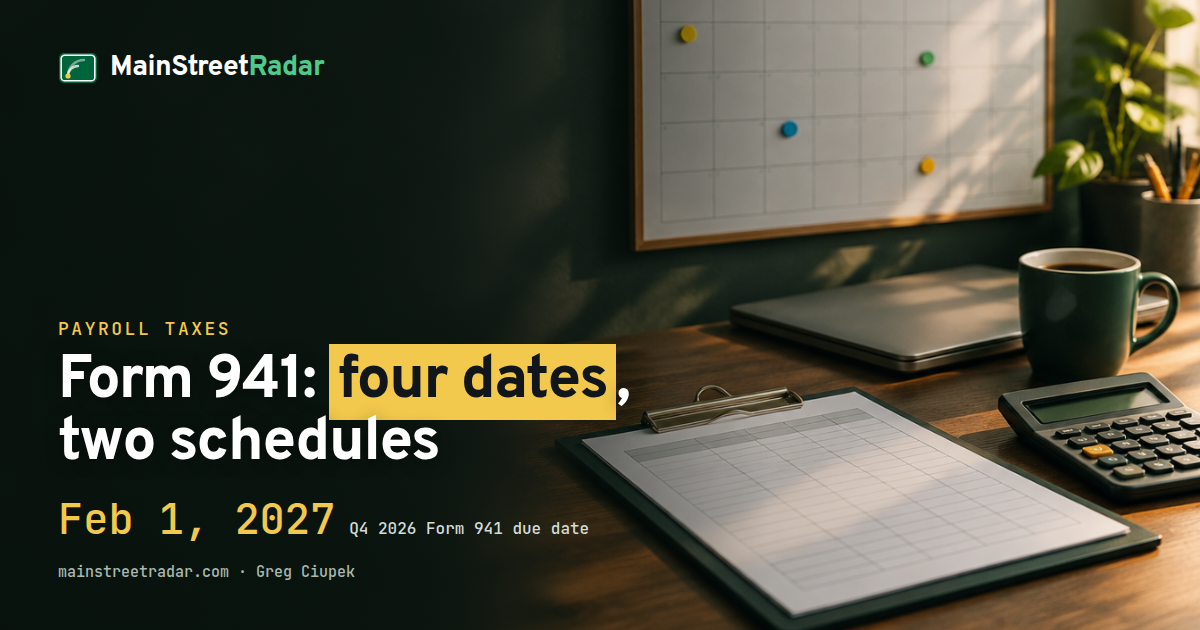
- Form 941 is due by the last day of the month after each quarter ends: April 30, July 31, October 31 and January 31, moved to the next business day when that date is a weekend or legal holiday.
- Form 941 for the fourth quarter of 2026 is due Monday, February 1, 2027, because January 31, 2027 is a Sunday. If you deposited all tax for the quarter on time, you have until February 10, 2027.
- Deposits are a separate schedule. You are a monthly depositor if your Form 941 taxes in the lookback period were $50,000 or less, and a semiweekly depositor if they were more.
- For 2026 the lookback period is July 1, 2024 through June 30, 2025. For 2027 it is July 1, 2025 through June 30, 2026.
- If you accumulate $100,000 or more of tax on any day, it is due the next business day, whatever your schedule.
This page is for small employers, including LLC owners and S corporation owners who run payroll for themselves, who want to know when Form 941 is due and how often to deposit the tax behind it. You will get the quarterly dates, the lookback test and the $2,500 and $100,000 rules.
It covers federal employment taxes reported on Form 941: withheld federal income tax and Social Security and Medicare tax. State income tax withholding, state unemployment tax and state payroll filings are not covered. Farm (Form 943) and Form 945 filers are not covered. MainStreetRadar is an independent site, not the IRS; for your own payroll, ask a CPA, an enrolled agent or a tax attorney.
When is Form 941 due each quarter?
According to the Instructions for Form 941 (revision 03/2026), the return is due by the last day of the month that follows the end of the quarter. If you made timely deposits in full payment of the quarter’s taxes, you may file by the 10th day of the second month after the quarter. Publication 15 adds that any filing date falling on a Saturday, Sunday or legal holiday moves to the next business day.
| Quarter | Wages paid | Form 941 due | If all tax deposited on time |
|---|---|---|---|
| Q4 2026 | October to December 2026 | February 1, 2027 | February 10, 2027 |
| Q1 2027 | January to March 2027 | April 30, 2027 | May 10, 2027 |
| Q2 2027 | April to June 2027 | August 2, 2027 | August 10, 2027 |
| Q3 2027 | July to September 2027 | November 1, 2027 | November 10, 2027 |
January 31, 2027 is a Sunday, July 31, 2027 a Saturday and October 31, 2027 a Sunday, so those three dates shift to the following Monday. The Q3 2026 return was due November 2, 2026 (October 31 was a Saturday). All dates are also on our small-business tax deadlines calendar.
You file Form 941 every quarter once you start paying wages, even for a quarter with no taxes to report, unless you file a final return, are a seasonal employer, or the IRS has notified you in writing that you may file the annual Form 944 instead. Publication 15 says employers that expect $1,000 or less of employment tax for the year can ask the IRS to file Form 944, during the first calendar quarter.
Monthly or semiweekly: which deposit schedule are you on?
The Form 941 due date is when you report. Deposits are when you pay, and for most employers they come earlier and more often. Publication 15 (2026) is explicit that your schedule “isn’t determined by how often you pay your employees or make deposits”. It is set once a year, before the calendar year starts, from your lookback period.
For a Form 941 filer, the lookback period is the four quarters running from July 1 to June 30 that end in the prior year. Add the total taxes reported on line 12 of those four Forms 941:
Publication 15 gives the lookback period for 2026 as July 1, 2024 through June 30, 2025. Applying the same rule, the lookback for 2027 is July 1, 2025 through June 30, 2026, so the quarters you have already filed decide your 2027 schedule. Here is an illustrative employer whose payroll grew during that window:
- Q3 2025 Form 941, line 12
- $11,800
- Q4 2025 Form 941, line 12
- $12,400
- Q1 2026 Form 941, line 12
- $13,100
- Q2 2026 Form 941, line 12
- $13,900
Lookback total for 2027 (more than $50,000: semiweekly)$51,200
Two details from Publication 15 matter here. Amounts are taken as originally reported: corrections made later on Form 941-X do not change the lookback total. And a new employer is treated as having zero tax in any lookback quarter before it started, so a Form 941 filer is a monthly depositor for its first calendar year, unless the $100,000 rule applies.
What is the monthly deposit schedule?
Under the monthly schedule, you deposit the employment taxes on wages paid during a month by the 15th day of the following month. The deposit rules follow the date wages are paid, not the period the work was done. If you paid no wages in a month, nothing is due for that month.
A due date on a weekend or legal holiday is timely if the deposit is made by the next business day. Legal holiday here means a legal holiday in the District of Columbia; statewide holidays do not count. For a monthly depositor, the next few dates work out like this:
- Wages paid in November 2026: deposit by Tuesday, December 15, 2026.
- Wages paid in December 2026: deposit by Friday, January 15, 2027.
- Wages paid in January 2027: February 15, 2027 is Washington’s Birthday, so by Tuesday, February 16, 2027.
- Wages paid in February 2027: deposit by Monday, March 15, 2027.
The 2027 dates are our calculation; Publication 15 for 2027 was not yet posted.
How does the semiweekly deposit schedule work?
A semiweekly depositor deposits by paydays, not by months. Publication 15’s Table 2 sets two windows:
| If payday falls on | Deposit by the following | Example payday | Deposit due |
|---|---|---|---|
| Wednesday, Thursday or Friday | Wednesday | Friday, December 18, 2026 | Wednesday, December 23, 2026 |
| Saturday, Sunday, Monday or Tuesday | Friday | Tuesday, December 29, 2026 | Monday, January 4, 2027 |
The second example shows the holiday rule. A semiweekly depositor always gets at least three business days after the period closes. Friday, January 1, 2027 is New Year’s Day, so the deposit for a Tuesday, December 29 payday moves to Monday, January 4, 2027. That date is our calculation from the rule.
A semiweekly depositor that pays once a month still deposits only once a month, just on the semiweekly timetable. Semiweekly depositors must also attach Schedule B (Form 941) to every Form 941. And if two paydays in one semiweekly window fall in different quarters, Publication 15 requires separate deposits: its example is paydays on Wednesday, September 30 and Friday, October 2, 2026, with both deposits due Wednesday, October 7.
A business that pays weekly can be a monthly depositor, and one that pays monthly can be a semiweekly depositor. Publication 15 says the terms only identify which set of deposit rules you follow. Check the lookback total each year rather than assuming last year’s schedule still applies.
What is the $100,000 next-day deposit rule?
If you accumulate $100,000 or more in taxes on any day during a deposit period, you must deposit it by the next business day, whether you are a monthly or semiweekly depositor. The threshold is measured before nonrefundable credits.
A monthly depositor that hits $100,000 on any day becomes a semiweekly depositor from the next day, for the rest of that year and all of the following year. Publication 15’s example is a business that started in May 2026 and accumulated $40,000 on one payday and $60,000 two days later: it had to deposit the $100,000 the next business day and is a semiweekly depositor for the rest of 2026 and for 2027.
New business account offers, fee changes and deadlines, in one short email.
Can a small employer pay with Form 941 instead of depositing?
Sometimes. Publication 15 lets you pay with a timely filed Form 941 instead of depositing, without a penalty, if your total tax liability on line 12 for either the current quarter or the prior quarter is less than $2,500 and you did not trigger the $100,000 rule during the quarter. If you are not sure the current quarter will stay under $2,500, the publication says to deposit under the regular rules.
A monthly depositor may also pay a small shortfall with the return under the accuracy of deposits rule. No penalty applies if the shortfall is no more than the greater of $100 or 2% of the amount due, and it is made up by the makeup date.
- A one-person S corporation running a small owner salary with under $2,500 of Form 941 tax a quarter.
- A business whose prior quarter was under $2,500 and that is confident the current quarter will be too.
- Any quarter where you are unsure you will stay under $2,500.
- A quarter in which you accumulated $100,000 on any day.
- Amounts that should have been deposited: paying them with the return draws a 10% penalty.
How do you make deposits, and what if you are late?
All federal tax deposits must be made by electronic funds transfer. Publication 15 (2026) lists three free ways: EFTPS, IRS Direct Pay and your IRS business tax account. A payroll provider or tax professional can also deposit for you. A new employer that indicated a federal tax obligation when requesting its EIN is pre-enrolled in EFTPS and receives its PIN by mail; see our EFTPS enrollment guide, and if a deposit day arrives with an outage, check the IRS status page.
Failure-to-deposit penalty rates
Percent of the amount not properly or timely deposited, counted in calendar days from the due date
The penalties do not apply if the failure was due to reasonable cause and not willful neglect.
- Find your lookback total Add line 12 of the four Forms 941 from July 1 through June 30 before the year.
- Set the schedule $50,000 or less is monthly; more than $50,000 is semiweekly. New Form 941 filers start as monthly.
- Put deposit dates in your calendar The 15th of each month, or the Wednesday and Friday windows, adjusted for weekends and DC holidays.
- Watch the $100,000 day A single day at $100,000 means a next-business-day deposit and a switch to semiweekly.
- File Form 941 By the last day of the month after the quarter, or the 10th of the second month if every deposit was on time.
If you are taking on your first employee, our hiring checklist covers the forms that come before the first payroll.
Frequently asked questions
When is Form 941 due for the fourth quarter of 2026?
Monday, February 1, 2027. The normal date is January 31, but January 31, 2027 is a Sunday. If you deposited all the quarter’s tax on time, you may file by February 10, 2027.
How do I know if I am a monthly or semiweekly depositor?
Add the taxes reported on line 12 of your Forms 941 for the lookback period, the four quarters from July 1 to June 30 before the year. If the total is $50,000 or less you are a monthly depositor; if it is more, you are semiweekly.
What is the lookback period for 2027?
Applying the Publication 15 rule, it is July 1, 2025 through June 30, 2026. Publication 15 for 2026 gives the 2026 lookback period as July 1, 2024 through June 30, 2025.
When are monthly payroll tax deposits due?
By the 15th day of the month after the wages were paid. If the 15th is a Saturday, Sunday or DC legal holiday, the deposit is timely on the next business day.
Does Form 941 cover state payroll taxes?
No. Form 941 reports federal income tax withholding and Social Security and Medicare tax only. State income tax withholding and state unemployment tax have their own returns and deadlines, which this page does not cover.
Sources
- IRS, Publication 15 (2026), (Circular E), Employer’s Tax Guide: section 11 (lookback period, monthly and semiweekly schedules, legal holidays, $100,000 rule, accuracy of deposits, payment with return, EFT, deposit penalties) and section 12 (filing Form 941).
- IRS, Instructions for Form 941 (03/2026): When To File Form 941 table.
- IRS, Publication 509 (2026), Tax Calendars: 2026 legal holidays and weekend rule.
- IRS, About Form 941: current form and Schedule B.
- 26 CFR 31.6302-1: Treasury regulation on deposit schedules and the lookback period.
Checked on November 16, 2026 against irs.gov, the Internal Revenue Code and Treasury regulations. Tax rules change; the IRS forms and instructions for your tax year always prevail.
Ad From the publisher: Boardeon, an AI board for your business · Telofia, an AI receptionist that answers your callsVoxiora, an AI receptionist that answers your calls
Boardeon is run by JG INVEST P.S.A., the publisher of MainStreetRadar; the discount applies if you buy within 7 days of creating your account. Telofia and Voxiora are run by AI AGENT HUB P.S.A., a company connected with the publisher. Affiliate links.